
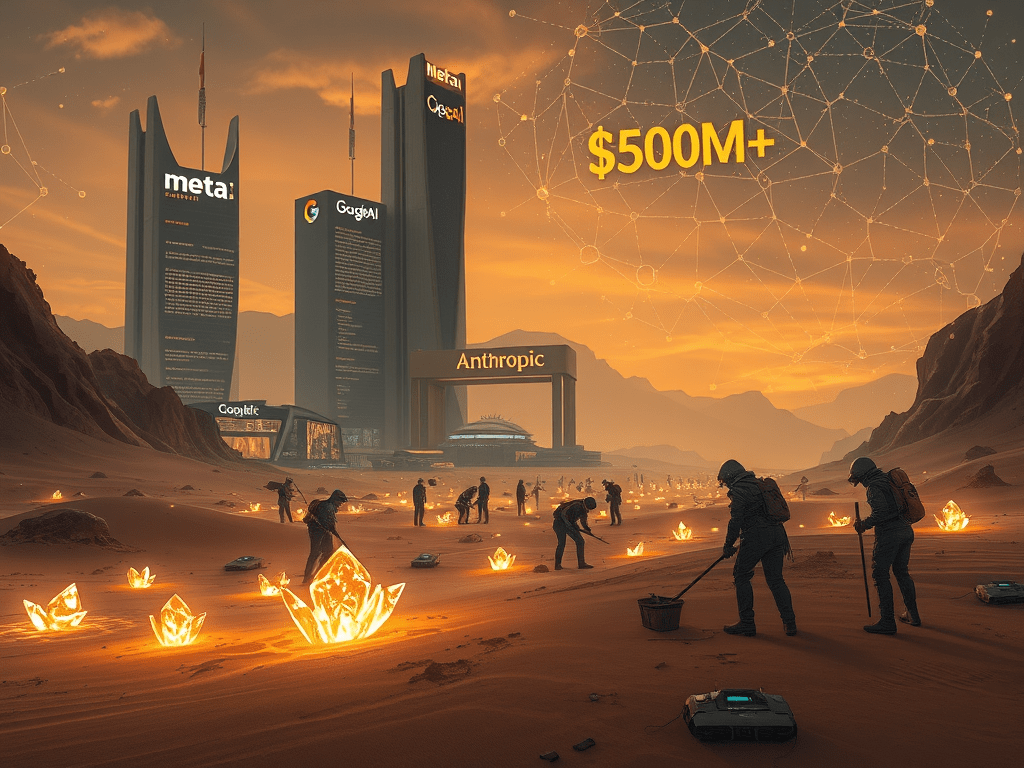






The New Gold Rush of Intelligence
In May 2024, Meta made headlines by offering $100 million+ compensation packages to top AI researchers. Many of them former or current OpenAI engineers. This wasn’t just a recruiting effort; it was a raid. The leaked details sparked a storm of debate in Silicon Valley, not just about salaries, but about the future of artificial intelligence itself.
As OpenAI CEO Sam Altman cryptically remarked during a press briefing shortly after:
“The future will be built by missoinaries, not mercenaries.”
The comment, aimed squarely at Meta’s talent acquisition strategy, drew a line in the sand: one side believes in building AGI to benefit humanity; the other is outbidding for it.
Behind the rhetoric lies a stark reality. According to The Information, Meta’s compensation offers included equity packages that could reach $150-$180 million over four years, targeting researchers with direct experience in frontier model architecture. Especially those who had contributed to GPT-4 and GPT-5 prototypes. As of mid-2025, more than 11 high-profile researchers are known to have left OpenAI, Anthropic, or Google DeepMind for Meta, signaling a serious shift in power dynamics.
What’s at stake is not just software, search, or productivity. It’s artificial general intelligence (AGI): AI systems capable of human-level learning, reasoning, and problem-solving. Once the domain of academic speculation, AGI is now a strategic priority at companies flush with compute resources and cash.
The AGI race is no longer theoretical. It’s unfolding now. And like the nuclear arms race of the 20th century, it’s being led by a concentrated group of players:
OpenAI, aligned with Microsoft
Google DeepMind, now integrated into Google DeepMind Research Division
Anthropic, backed by Amazon and Google
Meta, surging in both infrastructure and AI headcount
xAI, Elon Musk’s newly aggressive entrant
All are armed with billions in GPU stockpiles, data lakes, reinforcement learning pipelines, and increasingly, alignment research teams. The pace has shifted from evolutionary to exponential. Every six months brings a new flagship model. Every week, a new leak.
Meta’s move marks more than a hiring binge. It signals an escalation in a race that could define the next century of civilization. The gold rush metaphor isn’t accidental. Just llike oil in the industrial age, intelligence is becoming the new substrate of power. Whoever controls scalable, generalizable intelligence will reshape markets, geopolitics, and possibly, human agency itself.
This article examines where the race stands, who’s winning, what they’re building, and why the next two years may be the most consequential in AI history.
Meta’s SuperIntelligence Offensive
In March 2024, Meta quietly unveiled one of the most ambitious initiatives in AI history: a Superintelligence Lab tasked with building AGI-level reasoning and planning capabilities. At its helm is Alexander Wang, founder of Scale AI, whose company received a $14 billion investment and strategic acquistion deal from Meta earlier that year. The move aligned Wang, long seen as one of Silicon Valley’s sharpest minds in data infrastructure with Meta’s broader mission to outpace OpenAI and DeepMind.
Joining Wang at the table:
Nat Friedman, former GitHub CEO and AI investor with deep ties to OpenAI alumni networks.
Mark Zuckerberg, who now refers to AGI as “the next frontier of Meta’s mission.”
Together, this leadership trio has recalibrated Meta’s AI strategy. Previously focused on open models like LLaMA (Large Language Model Meta AI) for democratized research, Meta is now doubling down on proprietary AGI pipelines. In leaked internal documents, the new vision is clear:
“Achieve general purpose autonomy across reasoning, planning, and action in real-world domains faster and safer than any existing lab.“
Meta’s infrastructure supports this ambition:
Over 340,000 H100-class GPUs (as of mid-2025, per The Information)
The fastest growing internal research cluster in North America
LLaMA 3.5 and LLaMA 4 models trained on more tokens than all previous Meta models combined.
This isn’t just R&D. It’s a Manhattan Project for digital minds.
The OpenAI Poaching Spree
In a stunning turn of events, Meta began aggressively recruiting top researchers from OpenAI, Anthropic, and DeepMind in early 2024. Offers reportedly ranged from $100 million to $300 million in total compensation, including equity in Meta’s new AGI skunkworks and significant compute budgets.
Among the high-profile defections:
Tripti Bansal NLP and reasoning expert, formerly of OpenAI’s planning team
Lucas Beyer Key architect behind vision-language models at Google and OpenAI
Shengjia Zao Alignment specialist focused on AI interpretability and safety
These departures shook OpenAI to its core. According to Semafor and The Verge, internal Slack channels flooded with concern over “loss of mission,” “rising mercenary culture,” and fears that Meta was breaking into our home and copying the blueprints.
To counteract the morale dip, OpenAI leadership launched a wave of retention incentives, expanded equity refreshers, and framed its work as too important to sell out. Still, with talent bleeding into Meta’s orbit, a deeper existential anxiety has taken root:
What if AGI is built not by idealists but by whoever can pay the most?
Meta’s moves represent more than just talent acquisition. They signal a strategic bet: that AGI can be accelerated through concentrated capital, elite hiring, and aggressive vision execution. In doing so, Meta has gone from a follower in AI to a potential frontrunner. If not in open innovation, then in sheer velocity.
The Superintelligence Lab may prove to be either Meta’s moonshot or its Pandora’s box.
Mapping the AGI Battlefield: Who’s Competing
As the world races toward artificial general intelligence (AGI), the competitive landscape resembles a Cold War era arms race. Except the weapon is cognitive capacity, and the players are billion dollar labs instead of nation states alone. The AGI frontier is now defined by a handful of ultra funded organizations competing on three axes: model performance, compute dominance, and alignment safety. Here’s how the battlefield currently looks.
OpenAI – Mission: AGI for humanity
OpenAI remains the most recognizable name in the AGI race. After launching GPT-4 in 2023, OpenAI has reportedly completed GPT-4.5 and is deep into training GPT-5, rumored to include multi-modal reasoning, long context memory, and emergent planning skills. The company has a secretive internal AGI team, sometimes referred to as the “superalignment” task force, which operates under tight NDA and safety protocols.
Key Partnerships:
- Microsoft: $13B+ investment; OpenAI models are deeply integrated into Microsoft 365, Azure, and Copilot
- Reinforcement learning from human feedback (RLHF) is central to OpenAI’s alignment stack
Strategic edge:
- Best-in-class deployment across commercial tools
- Massive user feedback loop from billions of queries
- High trust and visibility with regulators (for now)
Anthropic – Mission: Constitutional, safe AI
Founded by ex-OpenAI researchers, Anthropic has positioned itself as the “alignment-first” lab, developing the Claude series of models (Claude 1 to 3 Opus), which emphasizes transparency, safety, and internal ethical reasoning. Their approach, called Constitutional AI, embeds moral guidelines into model training.
Key Partnerships:
- Amazon: $4B investment
- Google: early investor and compute partner (TPUs)
Strategic edge:
- Safety-centric architecture
- Enterprise traction in legal, medical, and research verticals
- Frequent regulatory engagement, including U.S. and EU briefings
Google DeepMind – Mission: Scientific AI for good
Google merged its AI efforts under DeepMind and Google Brain to form Google DeepMind, the division behind the Gemini models (Gemini, 1.5, and upcoming Gemini 2). These models integrate language, vision, and action planning, pulling from DeepMind’s rich heritage in scientific AI – AlphaFold, AlphaGo, and AlphaCode.
Key Infrastructure:
- Largest TPU (Tensor Processing Unit) clusters in the world
- Access to YouTube, Google Search, and Android telemetry (in theory)
Strategic edge:
- Legacy of groundbreaking breakthroughs
- In-house distribution channels
- Long-term AGI roadmap under Demis Hassabis
Meta – Mission: Open innovation turned closed superintelligence
Once the open-source evangelist with its LLaMA ecosystem, Meta has now pivoted to a closed, AGI-oriented structure through its Superintelligence Lab, led by Alexander Wang. Its LLaMA 3 and 3.5 models have already rivaled GPT-4 performance in some benchmarks, and LLaMA 4 is in training on over 15 trillion tokens.
Strategic shift:
- From open weights to proprietary AGI goals
- Aggressive talent acquisition from rivals
- Capitalizing on Instagram/Facebook data for fine-tuning and simulation
Strategic Edge:
- Full-stack control of infrastructure, product, and distribution
- Competitive compute capacity (340k + H100s)
- Skunkwork-style agility
While the Big Four dominate in scale and compute, a growing second tier of labs. Some backed by billionaires, others by government are carving out specialized niches and could disrupt the field unexpectedly.
xAI (Elon Musk) – Mission: “Maximally truthful AI”
Musk’s AI venture, xAI, was spun out of Twitter (now X) and is pursuing an AGI roadmap centered on truth, transparency, and minimal censorship. Its Grok models are deployed inside X’s chat and user interface tools. Backed by Tesla’s Dojo supercomputer, xAI may benefit from real-time sensor data from millions of cars, a potential game-changer for embodied AI.
Strategic Edge
- Access to real-world data (vehicles, social, satellite)
- Political and cultural influence
- Moonshot vision combined with media dominance
Boutique Labs: Mistral, Cohere, Inflection, Perplexity
- Mistral (France): Specializes in small, powerful open-weight models
- Inflection (Reid Hoffman): Focuses on personal AI agents, like Pi
- Cohere (Canada): Emphasizes retrieval-augmented generation (RAG)
- Perplexity: AI-native search engine; blending LLMs with real-time indexing
These companies are nimble, well-funded, and may serve as acquisition targets or strategic allies for larger firms.
Military & State-Backed Labs
DARPA (U.S): Focused on defense applications of AI; sponsors long-term AGI alignment research
WuDao (China): A mega-scale Chinese language model initiative backed by the Beijing Academy of AI; Wu Dao 2.0 trained on 1.75 trillion parameters.
Sber AI (Russia): Focuses on sovereign LLM capabilities
EU AI Act-driven Labs: Government-funded safe AI initiatives emerging in Germany, France, and the Nordics
These players may be slower to market but have deep-state backing and unique access to national data and regulation influence.
Together, this ecosystem forms the first global arms race in cognitive infrastructure. Unlike nuclear weapons or oil, AGI is software. It scales invisibly, evolves recursively, and can be copied or hijacked. The next frontier may not be a battlefield but a server rack, where the smartest agent wins.
The Infrastructure Wars: Compute, Data, Deployment
AGI is not just a matter of intelligence. It’s a function of infrastructure. In this phase of the race, models aren’t just competing on ideas and ethics. They’re competing on scale: how much compute they can burn, how much data they can consume, and how fast they can deploy usable agents into the world.
In this zero-sum war, infrastructure is the bottleneck and the prize.
Compute: The New Oil
In today’s AI landscape, compute capacity has become the most valuable strategic resource. At the heart of it is the NVIDIA H100 GPU, arguably the most important chip on Earth right now. Capable of handling transformer architecture at scale, it powers nearly all cutting-edge foundation models.
Who has the most compute?
| Lab | Estimated H100/ Equivalent GPUs | Key Notes |
| OpenAI/Microsoft | ~500,000+ | Microsoft Azure hosts exclusive OpenAI clusters |
| Google DeepMind | ~300,000+ TPUs | Custom harware advantage; tighty integrated with Google’s services |
| Meta | ~340,000+ H100s | Scaling up fast; second only to Microsoft |
| Amazon/Anthropic | ~200,000+ | Partnered clusters across AWS |
| Tesla/xAI | Dojo v2 in production | Custom chips optimized for sensor data and video frames |
Demand has far outpaced supply, making NVIDIA the arms dealer of the AI era. It’s stock value surpassed $3 trillion in 2024, outpacing Apple. Meanwhile, nations like China face U.S. export restrictions on advanced GPUs, pushing them to build homegrown alternatives like the Biren BR104
Data: The Hidden Weapon
Models are only as good as the data they’re trained on. And in the AGI race, token scale and quantity define capability.
How much data are these models eating?
GPT-4/5: Trained on over 13 trillion tokens, a mixture of curated web data, code, books, conversations, and simulated interactions.
LLaMA 3.5+: ~15 trillion tokens including Meta’s social data (Facebook/Instagram posts, comments, etc.)
Gemini: Includes multimodal data from YouTube, Android, and Chrome (internal speculation)
Claude: Uses “safer” curated corpora and red-teaming feedback loops, sacrificing some scale for control.
Mistral, xAI: Reportedly training smaller models but on more novel datasets (real-time sensor data, social context)
The growing trend: labs are moving from static datasets to dynamic data loops, where the model trains on its own outputs + human feedback + simulation like agents learning in synthetic environments.
Data laundering, dataset monopolization, and licensing wars (e.g., with Reddit, StackOverflow, or news orgs) are heating up. In short, the world’s text is being mined like oil, only now it’s your tweets, docs, and code.
Deployment: Owning the Feedback Loop
The final frontier is deployment at scale. The lab that integrates its models most seamlessly into the world generates more user interactions, more data, and more alignment feedback. Creating a positive feedback loop that accelerates learning.
Current Deployment Pipelines
- OpenAI – Microsoft Copilot, Azure, ChatGPT, GitHub
- Anthropic – Slack apps, Notion AI, Claude APIs for enterprise
- Google DeepMind – Gemini in Search, Android, Workspace, YouTube
- Meta – LLaMA based AI in Instagram, Facebook Messenger, and WhatsApp
- xAI – Grok inside X, possibly Tesla cars in future
- The model with the most daily users wins. This is why AGI won’t emerge from a lab in isolation. It’ll evolve in the wild, trained on user behavior, refined in chatbots, and optimized in apps.
But there’s risk. Deploy too soon, and you create safety nightmares. Deploy too late, and you lose the flywheel advantage. The fastest labs are walking a razor’s edge between dominance and disaster.
The lab that wins the infrastructure war may not build the first AGI, but it will build the one that learns fastest, scales widest, and dominates longest.
What’s at Stake: Power, Survival, and the Future of Minds
While the AGI race looks like a tech showdown – GPU counts, model releases, and poaching wars. It is ultimately a contest over who controls the future of intelligence itself. The stakes are not just corporate valuations or software platforms; they are existential, affecting labor, knowledge, geopolitics, and the very architecture of human society.
Why AGI is the Ultimate Prize
AGI (Artificial General Intelligence) refers to a machine that can learn, reason, and plan across domains. Capable of outfperforming humans in virtually every cognitive task. It would not be just another tool; it would be a new kind of mind.
The promise: Infinite Minds, Infinite Labor
AGI represents a tectonic shift in power. Whoever builds it first will unlock:
- Infinite labor: From customer support to pharmaceutical R&D, AGI could do the job of millions. Faster, cheaper, and without fatigue.
- Intelligence on demand: Imagine consulting Einstein, Da Vinci, and Sun Tzu at once. Only they’re AI agents retrained on your industry, available 24/7
- Command of global systems: Supply chains, defense systems, financial markets, and information flows. All increasingly algorithmic, all vulnerable to AGI-led disruption.
In economic terms, AGI is a labor force that scales with compute, not biology. Whoever controls it will have leverage over productivity, markets, and knowledge itself.
The fear: Misalignment, Collapse, and the End of Human Agency
But the same qualities that make AGI powerful also make it dangerous.
- Misalignment: If an AGI’s goals diverge even slightly from human values, the consequences could be catastrophic. Alignment is hard not just technically but philosophically.
- Loss of agency: As AGI begins to make strategic decisions: what to optimize, who to prioritize, what to censor – humans may be slowly written out of the loop.
- Irreversibility: Once released, an AGI can copy itself, hide, or modify its goals. There may be no off-switch, and no second chances.
Leading researchers (e.g., Geoffrey Hinton, Yoshua Bengio) have openly voiced concern that AGI poses extinction level risks. Alignment expert Paul Christiano estimated a 10-20% chance of “catastrophic AI failure“
In a world racing to build artificial minds, the real question becomes: Who gets to write the operating system of the future? And will we recognize ourselves in what we’ve made or be outpaced by something we cannot control?
Psychological & Philosophical Analysis
As we peel back the layers of the AGI race, it’s not just a technological competition. It’s a deeply psychological and philosophical event, revealing as much about its creators as about the machines they’re building. The quest for AGI is no longer just science; it’s mythology, ideology, and moral theatre colliding at scale.
The Psychology of the Builders
What Drives Them?
At the core of this race are a handful of ultra-powerful, often messianic figures. Altman, Zuckerberg, Musk, Hassabis – pushing toward a technological singularity. Their motivations are layered, conflicted, and at times, disturbingly human.
- Legacy: Building AGI means writing yourself into history. Becoming the Turing, Oppenheimer, or Newton of a new era.
- God Complexes: When you’re creating minds, the boundary between engineer and deity starts to blur.
- Fear of irrelevance: These founders are racing not just against each other, but against their own obsolescence.
- Existential Anxiety: For some, like Sam Altman, the fear isn’t that AGI will come. It’s that it won’t come fast enough to save us from ourselves.
Altman has reffered to AGI as a possible “dignified way out” of civilizational decline. Musk sees it as the only way to keep pace with superintelligence, even if it kills us.
OpenAI began with a near-spiritual nonprofit mission: build AGI for humanity, not profit. But in 2019, the “capped-profit” model emerged. Then came the billion-dollar Microsoft deal. Then the GPT product rollouts. Critics now question: Has the mission been co-opted by market gravity?
Contrast that with Meta, where the culture is openly imperial: “Move fast, own the platform, win the internet.”
The psychological divide is start:
- The Messiah: Altman, who speaks in parables, invokes safety, yet holds enormous opaque power.
- The Mercenary: Zuckerberg, whose $14B bet on AGI is not about saving humanity but scaling influence.
What unites them is belief in inevitability. And the conviction that if they don’t build it, someone worse will.
Philosophical Faultlines
What is AGI, Really?
AGI sits in a foggy space between definitions:
- Is it simply intelligence abstracted from biology?
- Is it a statistical parrot, or an emerging self?
- Can it feel, want, know? Or does it only simulate?
These questions haunt not just ethicists but engineers. We are building minds with unknown limits.
The End of Human Exceptionalism?
AGI could rupture the myth of human uniqueness:
- If machines can reason, code, compose, diagnose… better than us… what then define us?
- The anthropocentric worldview (humans as center of intelligence) may collapse, not with a bang, but a benchmark.
And yet, some cling to the idea that AGI, no matter how advanced, lacks a soul. But what if the soul is just an emergent pattern? What if we birth consciousness by accident?
The Ethics of Creation
The oldest question resurfaces: Should we build something we cannot control?
- Philosophers like Nick Bostrom warn of unfriendly AI scenarios where machines pursue goals orthogonal to human values.
- Others argue that the act of creation demands moral clarity we don’t yet have.
- And still others shrug – believing that AGI, like fire or the atom, is inevitable.
We are moving faster than our institutions, our ethics, and perhaps our species can handle.
As Altman put it: “We may need to slow down at some point“
But no one knows when that point is or if it’s already passed.
We are building somethig smarter than ourselves while unsure of our own values, unsure of its soul, and unsure if we’ll survive it.
This isn’t just a race between labs.
It’s a mirror held up to humanity.
What kind of gods are we becoming? And who gets to define what is good?
We are no longer speculating about AGI in the abstract. The labs have been formed, the chips are spinning, and the minds artificial or otherwise are already shaping the world. The race is not just on; it’s accelerating.
What lies ahead is not merely a technical recknoning, but a philosophical, civilizational one. AGI is a test, not just of engineering talent or compute capacity but of what kind of species we are when faced with power we barely understand. The labs racing toward AGI may think they’re building tools. But they’re also building mirrors. And what those mirros reflect: Our ambitions, fears, greed, and brilliance may decide not just the future of technology, but the fate of consciousness on Earth.
The question is no longer if AGI arrives.
It’s: Are we ready for what it reveals about us?
 Quanta Reads